Defining Cloud Computing Best Practices
In the rapidly evolving landscape of cloud computing, establishing best practices is crucial for organizations to optimize their cloud investments, mitigate risks, and maximize the benefits of cloud technologies.
Adhering to best practices in cloud computing offers numerous advantages, including improved security, enhanced scalability, increased cost efficiency, and accelerated innovation. Organizations can ensure compliance with industry standards, regulations, and internal policies by implementing these best practices.




Real-World Impact of Best Practices
Numerous real-world examples illustrate the positive impact of best practices on cloud computing implementations. For instance, a leading financial institution enhanced its security posture by adopting a comprehensive cloud security framework, resulting in a significant reduction in security breaches and compliance violations.
Another organization, a global manufacturing company, achieved substantial cost savings by implementing a cloud cost optimization strategy, which involved right-sizing cloud resources, leveraging spot instances, and optimizing cloud usage patterns.
Security and Compliance
In the realm of cloud computing, ensuring robust security measures is of paramount importance. With data and applications hosted in a shared environment, organizations must take proactive steps to safeguard their assets and comply with industry regulations.
Implementing comprehensive security controls is crucial for protecting data from unauthorized access, theft, or manipulation. This includes employing encryption techniques to safeguard data in transit and at rest, implementing stringent access control mechanisms to regulate user permissions, and conducting regular security audits to identify and address vulnerabilities.
Encryption
Encryption plays a pivotal role in securing data stored in the cloud. By encrypting data, organizations can ensure that even if it is intercepted during transmission or while at rest, it remains unreadable to unauthorized individuals.
- Encryption algorithms, such as AES-256, provide robust protection against unauthorized access.
- Encryption keys should be securely managed and regularly rotated to prevent compromise.
- Encryption can be applied at various levels, including data, files, and databases, to ensure comprehensive protection.
Access Control
Access control mechanisms are essential for regulating user access to cloud resources and data. Implementing granular access controls allows organizations to define specific permissions for different users and groups, ensuring that only authorized individuals have access to sensitive information.
- Role-Based Access Control (RBAC) is a widely used access control model that assigns permissions based on user roles.
- Least Privilege Principle dictates that users should be granted only the minimum level of access necessary to perform their job duties.
- Multi-Factor Authentication (MFA) adds an extra layer of security by requiring users to provide multiple forms of identification before accessing cloud resources.
Regular Security Audits
Regular security audits are crucial for identifying vulnerabilities and ensuring that security controls are functioning effectively. These audits should be conducted by qualified security professionals and should cover all aspects of the cloud environment, including infrastructure, applications, and data.
- Security audits should be conducted on a regular basis, at least annually or more frequently if required by regulations.
- Audits should focus on identifying vulnerabilities, misconfigurations, and compliance gaps.
- Remediation plans should be developed and implemented promptly to address any identified vulnerabilities.
Compliance Requirements and Industry Regulations
Organizations operating in the cloud must comply with various industry regulations and standards that govern data protection and security. These regulations may include:
- General Data Protection Regulation (GDPR) in the European Union
- Health Insurance Portability and Accountability Act (HIPAA) in the United States
- Payment Card Industry Data Security Standard (PCI DSS) for organizations that process credit card information
Compliance with these regulations is essential for protecting sensitive data and maintaining customer trust. Organizations should carefully review and understand the requirements of these regulations and implement appropriate security measures to ensure compliance.
Cost Optimization and Efficiency
Optimizing costs and achieving efficiency are critical aspects of successful cloud computing. Employing effective strategies can help organizations minimize expenses while maximizing the value derived from cloud services.
To achieve cost optimization and efficiency in cloud computing, organizations should consider the following strategies:
Rightsizing Resources
Properly sizing cloud resources, such as compute, storage, and network capacity, is essential to avoid overprovisioning or underprovisioning. Regularly review resource utilization metrics to identify opportunities for rightsizing. Implement autoscaling mechanisms to adjust resource allocation based on demand.
Utilizing Cost-Effective Pricing Models
Cloud providers offer a variety of pricing models, including pay-as-you-go, reserved instances, and spot instances. Choose the pricing model that best aligns with your usage patterns and budget constraints. Consider long-term commitments for reserved instances or spot instances to secure discounted rates.
Leveraging Automation
Automation can significantly reduce operational costs and improve efficiency in cloud computing. Automate tasks such as provisioning, configuration, and maintenance of cloud resources. Use automation tools to optimize resource allocation, identify cost-saving opportunities, and respond to changing demands.
Capacity Planning and Performance Monitoring
Conduct thorough capacity planning to forecast future resource requirements and avoid unexpected costs. Continuously monitor cloud resource utilization, performance metrics, and application behavior to identify potential bottlenecks and areas for improvement. Adjust resource allocation and application architecture as needed to optimize performance and cost-effectiveness.
Optimizing Application Architecture
Design and architect cloud applications with efficiency in mind. Consider factors such as scalability, fault tolerance, and resource utilization. Employ techniques like microservices, serverless computing, and containerization to improve agility and cost-effectiveness.
Continuous Monitoring and Adjustment
Regularly review cloud resource usage, costs, and performance metrics to identify opportunities for further optimization. Adjust cloud resource allocation, pricing models, and application architecture as needed to maintain cost-effectiveness and improve efficiency.
Performance and Scalability

Ensuring high performance and scalability is critical in cloud computing environments to handle fluctuating demands, ensure responsiveness, and deliver a seamless user experience. It involves designing and implementing cloud architectures that can efficiently scale up or down based on changing workloads, while maintaining optimal performance.
Best practices for designing and implementing scalable cloud architectures include:
Load Balancing
Distributing incoming traffic across multiple servers or resources to optimize resource utilization, improve responsiveness, and prevent overloading. Load balancers can be hardware-based or software-based, and they can be configured to distribute traffic based on various factors such as server capacity, response time, and geographic location.
Auto-scaling
Automatically adjusting the number of resources (e.g., servers, containers) based on changing demand. Auto-scaling helps ensure that resources are allocated efficiently, reducing costs during low-demand periods and preventing performance bottlenecks during high-demand periods.
Distributed Computing
Breaking down tasks into smaller, independent subtasks and distributing them across multiple servers or resources for parallel processing. Distributed computing can significantly improve performance and scalability, especially for data-intensive or computationally intensive applications.
Performance optimization techniques include:
Caching
Storing frequently accessed data in a high-speed memory cache to reduce the number of times it needs to be retrieved from the main memory or storage. Caching can significantly improve performance, especially for applications that involve frequent access to the same data.
Content Delivery Networks (CDNs)
A network of geographically distributed servers that deliver content to users based on their location. CDNs reduce latency and improve performance by delivering content from the server closest to the user, reducing the distance that data needs to travel.
Database Indexing
Creating an index for a database table to improve the speed of data retrieval. An index is a data structure that organizes the data in a way that makes it faster to find specific records. Indexing can significantly improve performance for queries that involve searching or filtering data.
Data Management and Backup

In cloud computing, effective data management and backup strategies are paramount to ensure the integrity, accessibility, and security of your data. A robust data management plan provides a systematic approach to organizing, protecting, and maintaining your data, while regular backups safeguard against data loss or corruption.
Data Protection
Data protection measures are essential to safeguard your data from unauthorized access, theft, or loss. Best practices include:
- Data Encryption: Encrypt data at rest and in transit using robust encryption algorithms to protect it from unauthorized access.
- Data Replication: Implement data replication strategies to create multiple copies of your data across different locations or cloud regions, ensuring redundancy and availability.
- Regular Backups: Regularly back up your data to a separate and secure location. This ensures you have a recent copy of your data in case of data loss or corruption.
Data Governance and Data Quality Management
Data governance and data quality management are critical aspects of ensuring the accuracy, consistency, and integrity of your data in the cloud.
- Data Governance: Establish clear policies and procedures for data management, including data access controls, data retention policies, and data security measures.
- Data Quality Management: Implement data quality checks and processes to ensure the accuracy, completeness, and consistency of your data. This includes data validation, data cleansing, and data standardization.
Disaster Recovery and Business Continuity
The cloud computing landscape demands a comprehensive disaster recovery and business continuity plan to mitigate potential risks and ensure uninterrupted operations. A well-designed plan safeguards critical data, minimizes downtime, and maintains business functionality during unexpected disruptions.
Regular Testing and Failover Procedures
Regular testing of disaster recovery plans is paramount to ensure their effectiveness. This involves simulating disaster scenarios, evaluating system responses, and identifying areas for improvement. Failover procedures should be clearly defined and practiced to ensure a smooth transition to backup systems in the event of a disaster.
Data Backup and Replication
Data backup and replication play a crucial role in ensuring business continuity during a disaster. Regularly backing up critical data to secure off-site locations provides a reliable recovery point in case of data loss. Replication involves maintaining multiple copies of data across different geographical locations, enhancing data availability and reducing the risk of data loss due to localized disasters.
Monitoring and Analytics
Continuous monitoring and analytics are crucial for cloud computing as they enable organizations to gain visibility, control, and insights into their cloud infrastructure and applications. By collecting, analyzing, and visualizing cloud performance metrics, organizations can optimize resource utilization, identify potential issues, and ensure high availability and performance of their cloud-based services.
Best Practices for Collecting, Analyzing, and Visualizing Cloud Performance Metrics
- Establish Clear Objectives: Define specific goals and objectives for monitoring and analytics, such as improving performance, optimizing costs, or enhancing security.
- Select Relevant Metrics: Identify key performance indicators (KPIs) that align with your objectives, such as CPU utilization, memory usage, network bandwidth, and application response times.
- Use a Centralized Monitoring Platform: Implement a centralized platform or tool that collects and consolidates data from various cloud resources, including virtual machines, storage, and networking components.
- Enable Real-Time Monitoring: Configure continuous monitoring to detect issues and anomalies in real time, allowing for prompt response and remediation.
- Visualize Data Effectively: Utilize dashboards, graphs, and other visualization tools to present complex data in an easily digestible format, enabling quick identification of trends and patterns.
Leveraging AI and ML for Predictive Analytics and Anomaly Detection
- Predictive Analytics: Employ AI and ML algorithms to analyze historical data and identify patterns that can predict future trends, such as resource usage patterns or potential performance bottlenecks.
- Anomaly Detection: Utilize ML algorithms to detect anomalies or deviations from normal behavior, indicating potential issues or security breaches.
- Automated Remediation: Integrate AI-driven automation to respond to detected anomalies and issues promptly, reducing manual intervention and improving overall efficiency.
Governance and Compliance
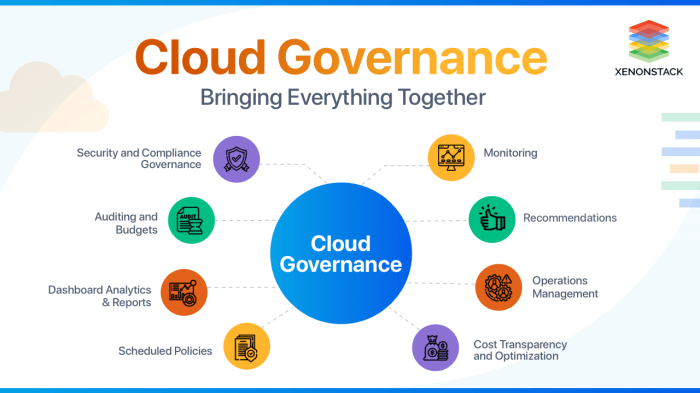
Establishing clear governance and compliance policies for cloud computing is essential to ensure accountability, transparency, and adherence to industry regulations.Effective cloud governance involves defining roles and responsibilities, implementing access controls, and ensuring compliance with industry regulations. This helps organizations maintain control over their cloud environments, mitigate risks, and meet regulatory requirements.
Defining Roles and Responsibilities
Clearly defined roles and responsibilities are crucial for effective cloud governance. This includes identifying stakeholders, assigning roles and responsibilities, and establishing clear lines of communication and accountability. Roles may include cloud architects, cloud administrators, security personnel, and business stakeholders.
Implementing Access Controls
Access controls are essential for securing cloud environments and ensuring compliance. Organizations should implement strong access controls, such as role-based access control (RBAC), multi-factor authentication (MFA), and least privilege access, to prevent unauthorized access to cloud resources.
Ensuring Compliance with Industry Regulations
Organizations operating in regulated industries, such as healthcare, finance, and government, must comply with industry-specific regulations. Cloud providers offer various compliance certifications, such as ISO 27001, HIPAA, and PCI DSS, to help organizations meet these requirements.
Cloud Governance Tools and Platforms
Cloud governance tools and platforms can automate compliance and monitoring adherence to policies. These tools provide centralized visibility into cloud environments, enabling organizations to track resource usage, identify security risks, and ensure compliance with regulations.
Innovation and Continuous Improvement
Fostering a culture of innovation and continuous improvement is crucial in cloud computing to stay competitive and drive digital transformation. This involves encouraging experimentation, adopting new technologies, and leveraging cloud platforms for innovation. Cloud computing enables businesses to quickly test new ideas, scale resources as needed, and iterate rapidly.
Embracing Experimentation and Adopting New Technologies
Cloud computing provides a flexible and cost-effective platform for experimentation. Businesses can easily spin up new environments, test different configurations, and deploy new applications without significant upfront investments. This encourages a culture of experimentation and innovation, allowing businesses to explore new ideas and identify new opportunities.
Leveraging Cloud Platforms for Innovation
Cloud platforms offer a wide range of services and tools that can be leveraged for innovation. These include machine learning, artificial intelligence, analytics, and Internet of Things (IoT) capabilities. By leveraging these services, businesses can develop innovative solutions, improve operational efficiency, and gain valuable insights from data.
Cloud Computing Driving Digital Transformation and New Business Models
Cloud computing is a key enabler of digital transformation, allowing businesses to adopt new technologies, streamline operations, and create new business models. It provides the agility, scalability, and cost-effectiveness needed to quickly adapt to changing market dynamics and customer demands.
Cloud computing also enables businesses to create new products and services, such as mobile apps, e-commerce platforms, and IoT solutions, that were previously not feasible or cost-effective.
Final Summary
In conclusion, the pursuit of best practices in cloud computing is an ongoing endeavor, demanding a proactive approach to innovation and continuous improvement. By embracing these guiding principles, organizations can unlock the full potential of the cloud, driving digital transformation, fostering agility, and securing a competitive edge in the modern business landscape.